
Project Status Update - week 11
We're slowly landing in production mode and leaving the frantic bring-up pace behind. So fewer features and more day-to-day things this week, and that is a very, very good sign.
(Knock on wood: no disastrous new vulnerabilities this week, either.)
pkg and dispatch are 1.0.0
I already wrote a whole post about this, so here's the short version. The second number of the version is now the manifest schema. When a repository moves to a schema that your pkg doesn't understand yet, pkg stops, and the only thing it will install is a newer pkg, and that's one that understands it.
Most of the work wasn't the version number itself. It was making sure pkg can never end up half upgraded:
pkgholds back any package that was published in a newer schema, and refuses a transaction that would mix old and new.- Upgrading
pkgmoves its whole closure into place, then runs the new binary to prove it works, before it calls the upgrade done. - Every place that can replace
/usr/bin/pkgis now guarded the same way. pkg check-updatesees a newer schema too, and tells you what to do instead of giving advice that leads nowhere.- The repository server publishes the new index format next to the old one, and keeps the old one until it's retired. Older
pkgversions keep working in the meantime.
If you haven't yet:
$ sudo pkg upgrade pkgThat gets you a pkg-1.x.
This week's image releases
All five images are new, as 2026.11.2: Live USB, ISO, cloud, container and WSL. They're mostly a refresh with this week's packages, plus one thing worth pointing out:
- These are the first images with signed SBOMs, both SPDX and CycloneDX. There's more on that below.
This week's content releases (packages)
- Games: SuperTuxKart, The Battle for Wesnoth, Warzone 2100, Endless Sky, freeciv, and BZFlag. Sadly I have very little time to test them.
- Developer tools: rr (record and replay debugging), difftastic, crosstool-ng, all contributed by Dan Partelly, through our Forgejo instance, as actual pull requests! Thanks, Dan!
- ccache 4.14.3 and help2man
- Network tools: Wireshark 4.6.9, Remmina, FRR 10.7.1, libsmi and libmaxminddb, also courtesy of Dan.
- Plasma: Dolphin and its plugins, now in the Plasma set along with Noto Emoji, plus extra-cmake-modules 6.32.0 and kirigami-addons
- Xfce: udisks2 is now in the set, so removable drives mount in Thunar
- Weston 16.0.2, which also powers our GUI package tests (see below)
- Mesa 26.3.0, Qt 6.12.0 (qtbase and PySide6), GStreamer 1.28.9, glib 2.90.1
- PostgreSQL 18.7, MariaDB 13.1.1, CUPS 2.4.20, dbus 1.16.4, krb5 1.22.3
- llama.cpp 1.0.0, crun 1.31, LXC 7.0.0, ostree 2026.7, rclone 1.76.0, lazygit 0.66.3
- Base: CMake 4.5.0, Automake 1.20, flex 2.6.11, p11-kit 0.26.6, lz4 1.11.1, patch 2.8.1, and respins of glibc, ncurses and gdb
- intel-ucode 20261110, with this month's Intel microcode fixes
linux-kernel-stable 7.3.5 lands later today, moving us from the 7.2 series, which just went EOL, to 7.3.
This week's bugs and issues
- rr ships a library that breaks when it's stripped. Recipes can now name files with
[build] strip_exclude, and those ship exactly as they were installed. If a pattern matches nothing, the build fails, so a typo or an upstream rename can't quietly strip the file again. It's a last resort, only for a file that's confirmed to break when stripped. Needing it at all points to a design problem upstream. - A package could claim a soname for a library it didn't actually ship. Now a soname is only provided when a file with that name exists.
pkgcould report a source asMISSINGwhen it was there, but unreadable for another reason. It now only saysMISSINGwhen it's actually missing.- Removing packages got a lot faster.
pkg-gcused to read every ELF file in full to check what libraries it needs. It now skips that check when no library is going away, and reads only the part of the file it needs when it does. - A test host that ran out of disk space would report the test as incomplete, and it looked like the package was at fault. Now it counts as a problem with the test host.
Reproducibility audit
- No new reproducibility failures were found this week.
- A new test checks that the same OCI image, composed seconds apart, comes out the same. Image SBOMs no longer carry the time of the build, so they're reproducible too.
The reproducibility audit runs 24/7 and continues to rebuild existing packages over and over to validate our reproducible builds promise. Verifying reproducible builds shows how to rebuild a package yourself.
This week's dispatch changes (the builder and pkg)
CVE decisions
The CVE framework from the last two weeks is now getting a lot of use, so I spent time making it faster to work with:
- A CVE decision is made per vulnerability, not per package, and every decision can be undone.
- The review dialogs show what was decided for the same package before, and why. Most of the time the answer is the same, and now I don't have to look it up.
- The identity dialogs show what the review agent thinks, next to the evidence. The agent now runs all the time, and gives its opinion as soon as a scan comes in. Before it was tediously slow to pick up work.
- The license review reads the packages that are waiting on it first.
None of this changes who decides. The agent gives an opinion, I make the call, and the reason is recorded with it.
SBOMs
This was the other big one. The SBOMs that dispatcher publishes are now:
- Signed, with the signature in a standard DSSE envelope.
- Attached to the container image as OCI referrers, so tools that know how to look for them find them next to the image.
- Named properly: each SBOM says which product, release and date it describes, and who supplied it.
- Reproducible. The SBOM for an image no longer carries the time it was built, only the time the release was cut. Rebuild the same image, and you get the same SBOM.
pkg sbom --provenance also fetches its records in parallel, so it's a lot quicker on a large system.
The signing made it into 2026.11.2. The product, release, date and supplier fields landed after those images were cut, so they'll arrive with the next ones.
dispatch-web
dispatch-web got a big cleanup. Every list is one long table, it sorts by any column, and it has the same filter box on every page. There's also a new action list on the left edge of the screen. It shows everything that's waiting on me, with red and yellow counts kept apart, and links that take me straight to those items.
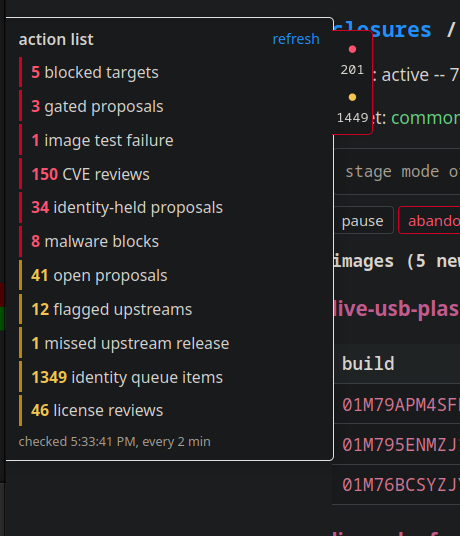
The action list - everything waiting on me, red before yellow, checked every two minutes
pkg memory consumption
I detected that when trying to run the Xfce image in a VM with just 1 GiB of RAM, it would stall or even OOM sometimes. The root cause was that pkg was consuming about 600 MiB per job in a test that ran three jobs in parallel, and thus conked out. Turned out that pkg was duplicating some tables in memory that weren't needed, and we could bring it down to ~450 MiB or so, without major rewrites or changing how the current flow runs.
Testing
Two big steps for the testing framework this week.
First, over 90 base packages now have a functional test of their own. That covers the toolchain (gcc, binutils, LLVM, Rust, Go), the build tools (make, CMake, meson, ninja, autoconf, automake), the core system (glibc, coreutils, bash, systemd, util-linux, PAM) and the libraries everything depends on (openssl, gnutls, zlib, sqlite, python, perl). The gcc test, for example, compiles a C and a C++ program and runs them. That's a pretty good sign the compiler works.
Second, packages with a GUI can now be tested too. The test runner starts a private, headless Weston, opens the program, and captures its window. On top of that, every application in a desktop's menu gets opened, and its window is compared against a known good picture.
That second part is how the Live USB stick is tested now. Next to the Live USB we publish, there are Plasma and Xfce sticks that exist only for testing. The Live USB already installs either desktop, so that's all most people need. Each suite boots its stick, opens every app in the menu, and checks that each one shows up looking the way it should. It even presses the power button, and checks that the desktop asks what you want to do.
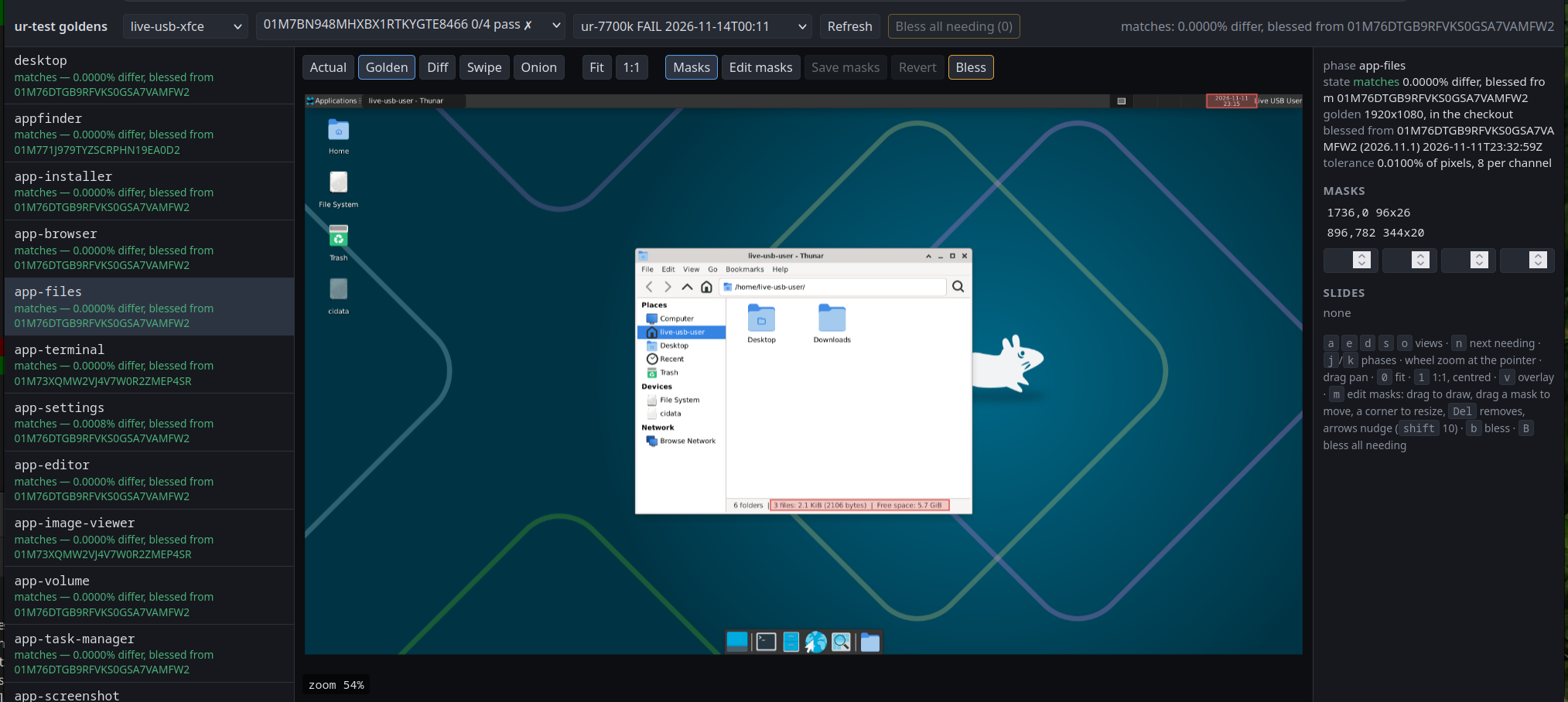
A golden with its masks in place - the clock and the free space change on every run, so they're left out of the comparison
ur-test-tui can now run as a web page (--web), so I can look at test results and compare screenshots from any machine.
Documentation and website changes
- One dot Oh, on pkg and dispatch 1.0.0
- New images, 2026.11.2, on the download page
What's next
The SBOMs are close to what CISA recommends, but not all the way. The next builds need to name the supplier properly, and after that I'll be happy to say they're complete.
Security advisories are still high on the list. Now that every package has a CVE identity and every decision is recorded, publishing them is mostly a matter of putting that data out there in a format others can use.
The test runner is still on my list to push to our Forgejo instance, so that others can run it and write tests. With over 90 tests in place, there are plenty of examples to start from.
As always, hop on Discord and tell me what you'd like to see packaged, or what could be done better!
--sofar (aka Auke)