
One dot Oh
I was sick for a day, and I realized that postponing 1.0 was silly. There's no reason to hold off any longer.
We're releasing pkg and dispatch 1.0.0
I'm in the process of promoting pkg-1.0.0 and dispatch-1.0.0 (and components related to them) out to the repos. The code changes between this version and the last one before it are small, but the impact and significance are huge.
The 1.0.0 version changes how incompatible format changes are handled in the future. Forever. It codifies how these changes are handled by the program that produces them (dispatcher) and the program that consumes them (pkg).
The short version: the second number is now the manifest schema. When a repository moves to a schema that your pkg doesn't understand yet, pkg stops, and the only thing it will install is a newer pkg.
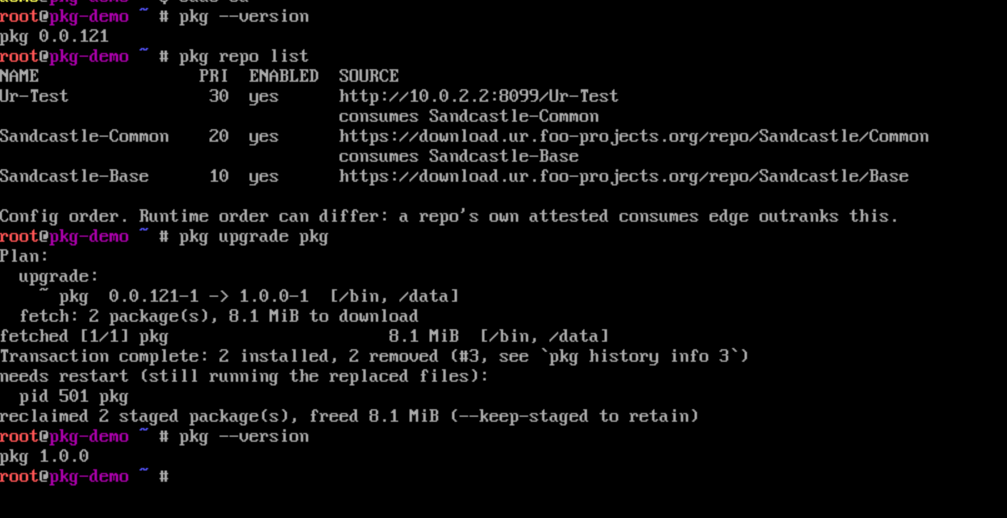
Upgrade testing before it goes out - the first upgrade past the post
Every part of 1.0.0 means something from now on
Before, only the last part had an actual meaning.
The first number: major
The first number is the major number in semver. Before the 1.0.0 release, the 0 meant... mostly nothing. After today, the 1 means a major change that is, according to semver, incompatible.
What is incompatible isn't that pkg-0.0.121 can't install or update to pkg-1.0.0, or that it can't downgrade. None of that. What changes is the contract: from 1.0.0 on, pkg knows about manifest schema versions. That's it - nothing more. For now.
The second number: minor
The second number is the minor number in semver. From today on, it's the manifest schema. A higher number means just that the schema changed. We start at 1.0.0 as the base, so the first schema change will make it go to 1.1.0.
pkg-1.3.x understands schema 1.3 and anything older. So if you're on 1.3.97 and wonder if your pkg is too old, you only have to look at the first two parts of the number. If the repository has moved to 1.4, your pkg is too old, and it will tell you so. If it's still at 1.3, you can install anything in it.
The last number: patch
The last number is the patch number in semver. This one doesn't change, it already had a meaning: it counts up with every release.
The manifest schema version, why does it exist, as of now?
We need a way to tell any pkg in the field that certain things in the repository were added recently, or even removed. The pkg version you have installed might be too old to understand a certain TOML key in the manifest data, or even unable to find required content in the content-addressed store.
What's worse, pkg had no way of understanding that this might happen. So your system could just stop updating one day, because a manifest has a new feature that pkg doesn't know, it throws a failure, and now you can't update anymore. And there are worse outcomes.
So today's change keeps future breaking changes from actually breaking anything. It just teaches pkg that these changes are natural, and how to handle them.
First: pkg knows when to stop
pkg won't upgrade itself automatically yet. But it already knows which manifest schema it supports, and that it doesn't support features from a future one. So it knows when to stop and say "Hey, you just asked me to do something with content I don't know how to handle yet, so you have to upgrade me first". That's the contract change that is made, today.
For safety reasons, if pkg encounters such a thing, it will only allow you to upgrade pkg on its own. It will refuse anything that sneaks in another package. That's the same rule the signing chain follows: don't trust what you can't verify.
Second: pkg will upgrade itself
In the future, pkg will upgrade itself first if it detects a new schema. This makes upgrades seamless. Any normal upgrade that runs into an updated schema will just perform a self-upgrade first, and then re-exec itself to perform the rest of the staged update with the new code. There will be virtually no manual intervention needed, as long as your pkg version is >= 1.0.0.
The schema is feature based
The schema is based on features that might (or will) be released, that change how things work internally. Recipes don't carry a schema. Only the manifests that dispatcher publishes do. If your pkg build fails with an unknown TOML keyword error, your pkg is too old or you mistyped something.
The schema lives on the manifest data, in the repository. If your dispatcher is new enough to give the pkg client new instructions for installation time, it could make a breaking change in a repository that older pkg versions don't understand. That would keep upgrades, installs, everything from working normally.
But there's no reason to rebuild the whole world to get new schema markers in every manifest either. If a new feature is needed, the build system adds it to the manifests that rely on it, and not to others. This lets features come and go in a natural way, without breaking anyone's updates. But users will have to upgrade their systems, so this isn't something we'll do often.
For anyone using pkg today - you must upgrade pkg!
Any pkg version lower than 1.0.0 will not detect that it could be reading manifest data it can't understand, and this could lead to any number of issues later on. So make sure you upgrade to a 1.x version. At some point soon, the first schema change will land, and then your upgrades will break, and it won't be obvious why.
Check your version with pkg --version, and upgrade just pkg with pkg upgrade:
$ sudo pkg upgrade pkg--sofar (aka Auke)