
Project Status Update - week 10
Lots of visible things this week. New images, a container registry, and the first per-package tests. Let's get into it.
This week's image releases
All five images are new, as 2026.11.1. The announcement has the details, but the short version:
- The installer can install the Plasma desktop directly, next to GNOME.
- Boot and shutdown are quiet: the logo, one line of
lowerthirdtext, and then the login screen. Press Esc for the boot menu. - The container is now a plain pull:
podman pull download.ur.foo-projects.org/sandcastle/container-base, or the same with docker. The download server writes a read-only registry view next to the published builds, so it's still just files, served by nginx. Every version is a tag, so you can pin by digest if needed.
The next image builds will also carry signed SBOMs. See the dispatch changes below.
As a side note: the Live USB image is a network installer. That has some downsides, but the installer stores the files it downloads on the USB stick, so you can reuse the stick for several installs without downloading everything again. It also means you can put the stick in a drawer and use it much later: it will still install the newest versions, and update the cache on the stick itself. In practice, very few bytes are downloaded twice, and you get a lot of flexibility.
This week's content releases (packages)
- Gaming: Lutris, MangoHud, GameMode and DOSBox Staging, with the Nuked-SC55 synth for that authentic Roland sound
- Containers: distrobox and toolbox
- Syncthing, rclone, lazygit and Foliate
- systemd 262.2, OpenSSH 10.6p2, NSS and ca-certs 3.133, zlib 1.4, expat 2.10.0, harfbuzz 15.1.0
- KDE Gear 26.08.3 (Konsole, Ark, Filelight and friends), mutter 51.1, GIMP 3.2.8, Inkscape 1.4.4
- libvirt 12.9.0, FreeRDP 3.33.0, gtk-vnc 1.6.0, SDL3 3.4.20, SVT-AV1 4.3.0
- Several respins of linux-kernel-stable 7.2.15
This week's bugs and issues
- The cloud image's instance-setup counted the time udev was busy against its wait for the config drive. On a slow first boot it could give up too early.
- live-init could wait forever on a disk whose PARTUUID shows up twice. It now times out.
boot-managerfailed when its initrd cache was unreadable. It warns now, and carries on.
Reproducibility audit
- Reported last week: cython-3.3.0 failed because of an unsorted list. Fixed by... sorting it. cython-3.3.0-3 builds reproducibly again.
The reproducibility audit runs 24/7 and continues to rebuild existing packages over and over to validate our reproducible builds promise. Verifying reproducible builds shows how to rebuild a package yourself.
This week's dispatch changes (the builder and pkg)
At a high level, I've been putting the new CVE framework to work. A package without a CVE identity is now refused: every package must have a known identity. That forces the operator (me) to review the CVEs against each package. It's step one for everything else: fast fixes, user notifications, audits. So now we can focus on the next steps.
Recipes that carry a patch file with CVE-YYYY-NNNN in its name are now automatically recorded as fixed. I don't generally write patches myself, but I will adopt upstream fixes that are already committed and not yet released. A "not affected" ruling can also hold from a version up now, so it doesn't have to be made again for every release.
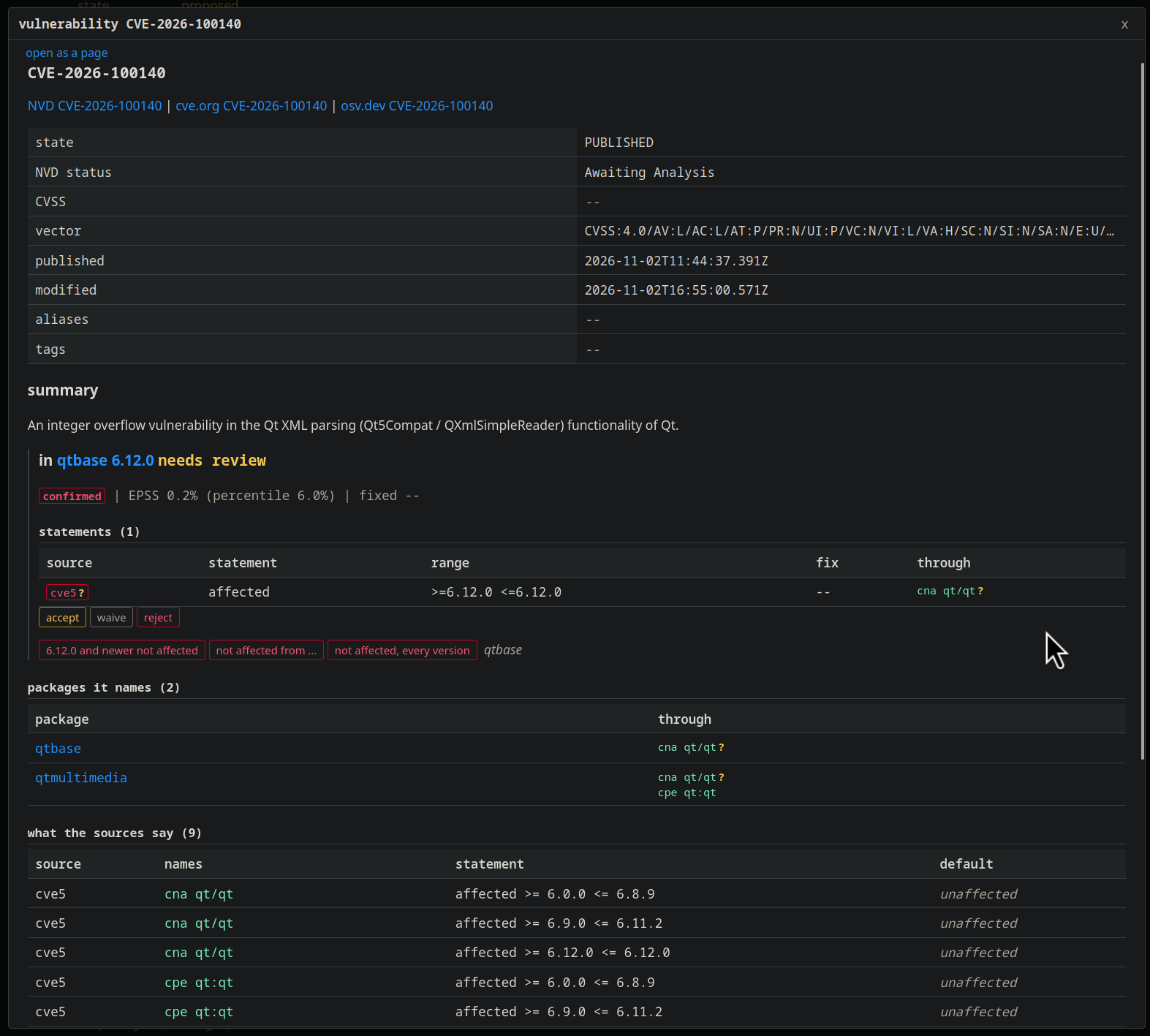
A CVE waiting to be decided - in this case the CVE shows this new qtbase carries the fix for this CVE.
Compliance: I'm wrapping up several improvements that bring our SBOMs much closer to what CISA recommends: signed SBOMs, and several missing fields properly filled in.
Testing
Our testing framework grew further. We now have reproducible build testing, image-based testing, unit testing and, new this week, functional package testing. The test runner code was revamped so that a single runner does reproducible build testing, image-based testing and package testing, which makes deployment a lot easier. I've expanded my test farm to 6 systems. All of these are providing valuable test results and finding little bugs, reproduction issues and other problems.
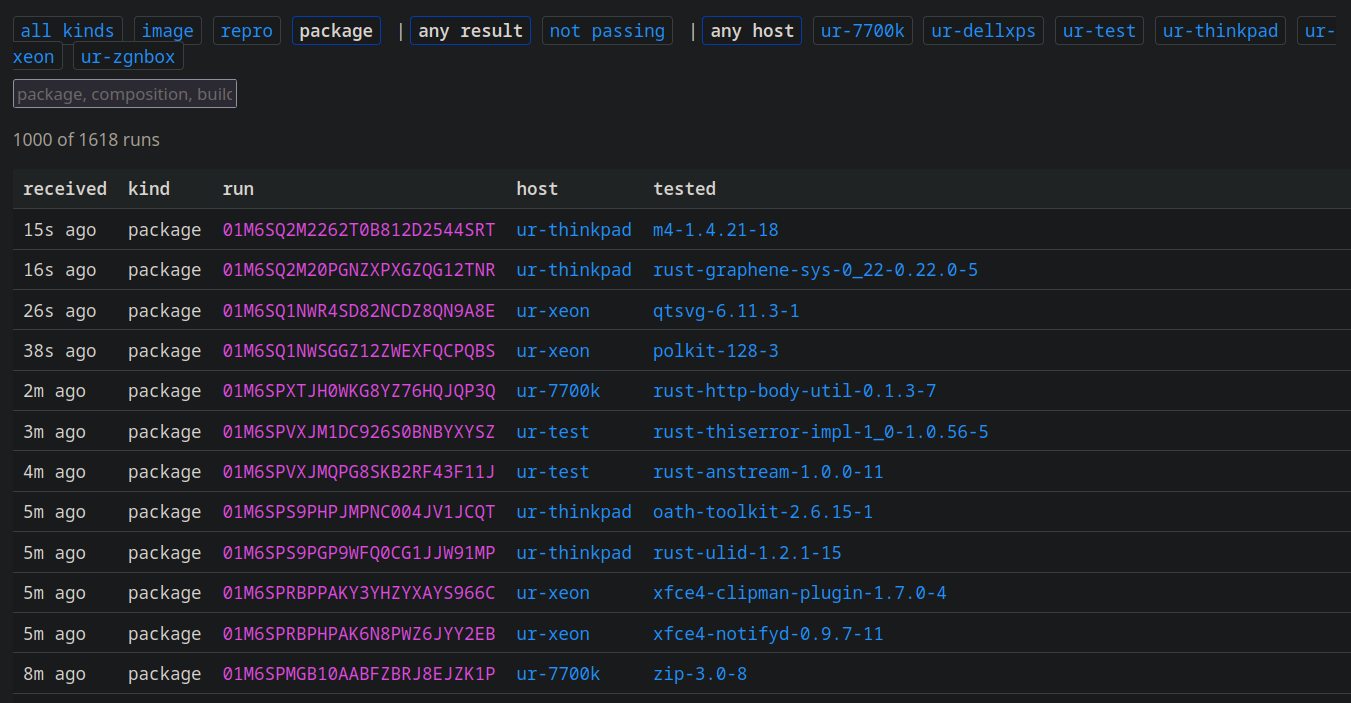
Package test results - runners continuously test packages
The test runners have a Lua-based scripting environment that separates and sandboxes the testing machine from the untrusted code running in the container. This protects the build environment from a possible backdoor payload, in line with defense-in-depth strategies to mitigate attacks. It's on top of the malware scans we do to make sure we're not importing trojans by accident.
Tests live in a published and signed central location, so test runners can fetch new tests without having to maintain a local copy. This makes deployment fast and simple: just install the test runner, drop a config .toml file in place, and run.
Documentation and website changes
- Container: pulling, running, building on it, pinning by digest, and the plain layout download as a fallback.
- Everything must be tested., on how we're going to test 2,000+ packages.
- New images - 2026.11.1
What's next
I hope to push the test runner code out to our Forgejo instance so that others can tap into it, and possibly write more tests.
For CVEs, as I said before, proper vulnerability announcements are high on the list of things we want working. Fixes for vulnerable packages are coming along well: the upstream watcher catches a lot, and it will remain what drives updates.
We've got some cool first pull requests and open issues! I'm happy to see that people are doing more than just booting it once. Please don't be shy: hop on Discord and ask for something you'd love to see packaged, or something you think could be done better!
--sofar (aka Auke)