
Project Status Update - week 13
This was a busy week, even with Thanksgiving in it. Buildroot-8.4 was blessed, new images went out, and pkg got two features I've been wanting for a while: pkg audit and tombstones. Plus, a batch of LTO enabled recipes.
Buildroot-8.4 and new images
Buildroot-8.4 was blessed over the weekend, with LLVM 23.1.6 and Rust 1.100.0. Sandcastle-Base now floors on it, and right after that the whole Rust world was rebuilt against the new compiler. That was 1,595 packages.
The new 2026.11.3 images are on the Download page. The installer can encrypt your disk now, the Live USB has input methods and CJK fonts, desktop installs get every translation, and they all come with kernel 7.3.6.
pkg audit
pkg audit tells you which of your installed packages have known vulnerabilities. Each repo now publishes a vulns.json.zst file that cve-watcher makes, and pkg audit compares what you have installed against it. The known exploited ones (KEV) are listed first, then it sorts by EPSS and severity.
If it has no CVE data for a package, it lists that package by name, so you won't mistake missing data for a clean system. If a repo can't be reached, it uses the last copy it verified, and tells you that it did.
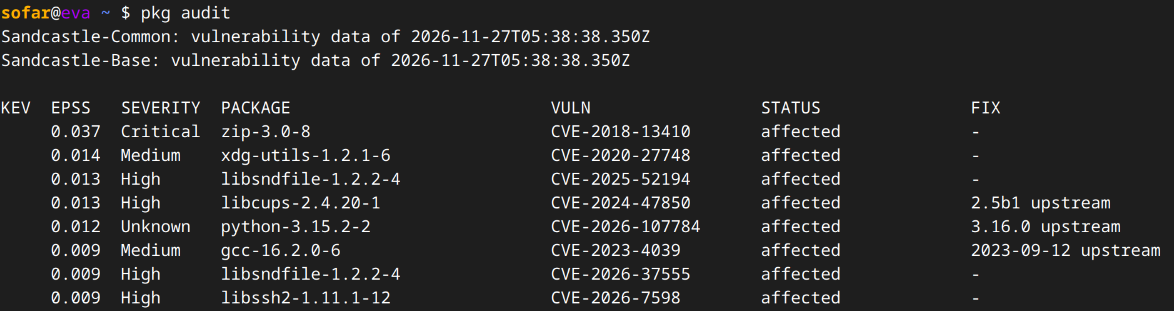
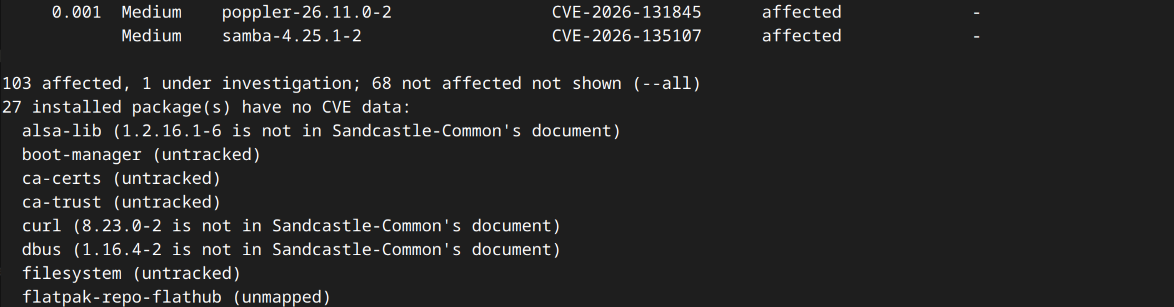
pkg audit output: affected (vulnerable) versions currently installed, and where the identity gaps are in the audit.
The file is signed and served through TUF like everything else in the repo. cve-watcher refreshes its data every 4 hours, but the published file only changes once every 8 hours at most, so you're not downloading a new copy all the time.
This is the first step to the security advisories that have been on the "What's next" list for a while.
There is still a backlog of packages without any identity (no CPE mapping). The way we are tackling this is twofold: First, updates to those identity-less packages are held, so they force me to assign missing identities in smaller chunks. And occasionally, I go and assign a batch by hand. Now that we have tools that display it, we can work on assigning identities where it is most needed. E.g. we'll be making sure that the Live USB is fully covered first, since this is something everyone will likely benefit from.
Tombstones
Until now, when we dropped a package from the repos, it just stayed on your system and never got another update. Now a registry can mark a recipe as a tombstone, and pkg upgrade will remove the package. If you want to keep it anyway, you can pin it locally. I found out while testing in a VM that the first version removed pinned packages too, so that's fixed.
This needs pkg 1.1.1 or newer, which is where the pkg goes first change from last week pays off: pkg upgrades itself first, and only then acts on tombstones. The feature is now fully implemented. Tombstones themselves will come in the next week.
Deleting outdated software is an important part of keeping you, the user, secured.
A CVE identity for our own software
Every first-party tree (dispatch, pkg, boot-manager, lowerthird, live-install and friends) now has a SECURITY.md that says how it's named in vulnerability records: vendor theurproject, its product name, CPE and repository, and where to report problems. The security page has the same.
We anticipate that at some point people will start auditing our code base and possibly try to break it. I'm actually hoping that people will do so. In that case, we also want them to be able to file vulnerabilities in the correct way with the proper identity, and these hints will make that possible.
This week's content releases (packages)
- LibreOffice 26.8.3.1, along with the import filter libraries it uses (libwps, libvisio, libmspub, libetonyek and so on)
- Enlightenment 0.28.0 and EFL 1.29.0, with terminology, rage, ephoto, evisum, edi, ecrire and entice, and a new
+enlightenment-desktopset - Fonts, lots of fonts: Noto for Arabic, Hebrew, Indic, Thai, Khmer, Georgian, Armenian and more scripts, IBM Plex, Inter, Source Sans and Serif, Fira Code, Cascadia, Intel One Mono, Terminus, Unifont and the symbols Nerd Font
- Plasma: okular, gwenview, elisa, kcalc, spectacle, discover, print-manager, kwalletmanager, flatpak-kcm and plasma-keyboard 6.8.3
- GNOME: gnome-control-center 51.2.1, nautilus 51.2, gdm 51.2, orca 51.2, gnome-maps 51.3, gnome-remote-desktop 51.1, gnome-boxes 50.1, glib 2.90.2
- From Dan Partelly: foot, grim, slurp, mako, kanshi, xdg-desktop-portal-wlr, wl-clipboard, wlr-randr, wdisplays, wlsunset, exult, qt-creator and several Qt modules, rtorrent, lnav, delve, tio, ldns, iodine, alsa-utils and more. Thanks again, Dan!
- Kernel 7.3.6, linux-firmware 20261124, expat 2.11.0, zstd 1.6.0, cryptsetup 2.8.9, shadow 4.20.4, dracut 113, edk2 202611
- Servers: nginx 1.31.10, haproxy 3.4.9, valkey 9.2.1, postfix 3.11.8, mariadb 13.2.1, podman 6.2.1
- pipewire 1.6.12, obs-studio 33.0.3, krita 6.0.5, flatpak 1.18.6, ansible-core 2.22.0, and llama-cpp 1.1.0
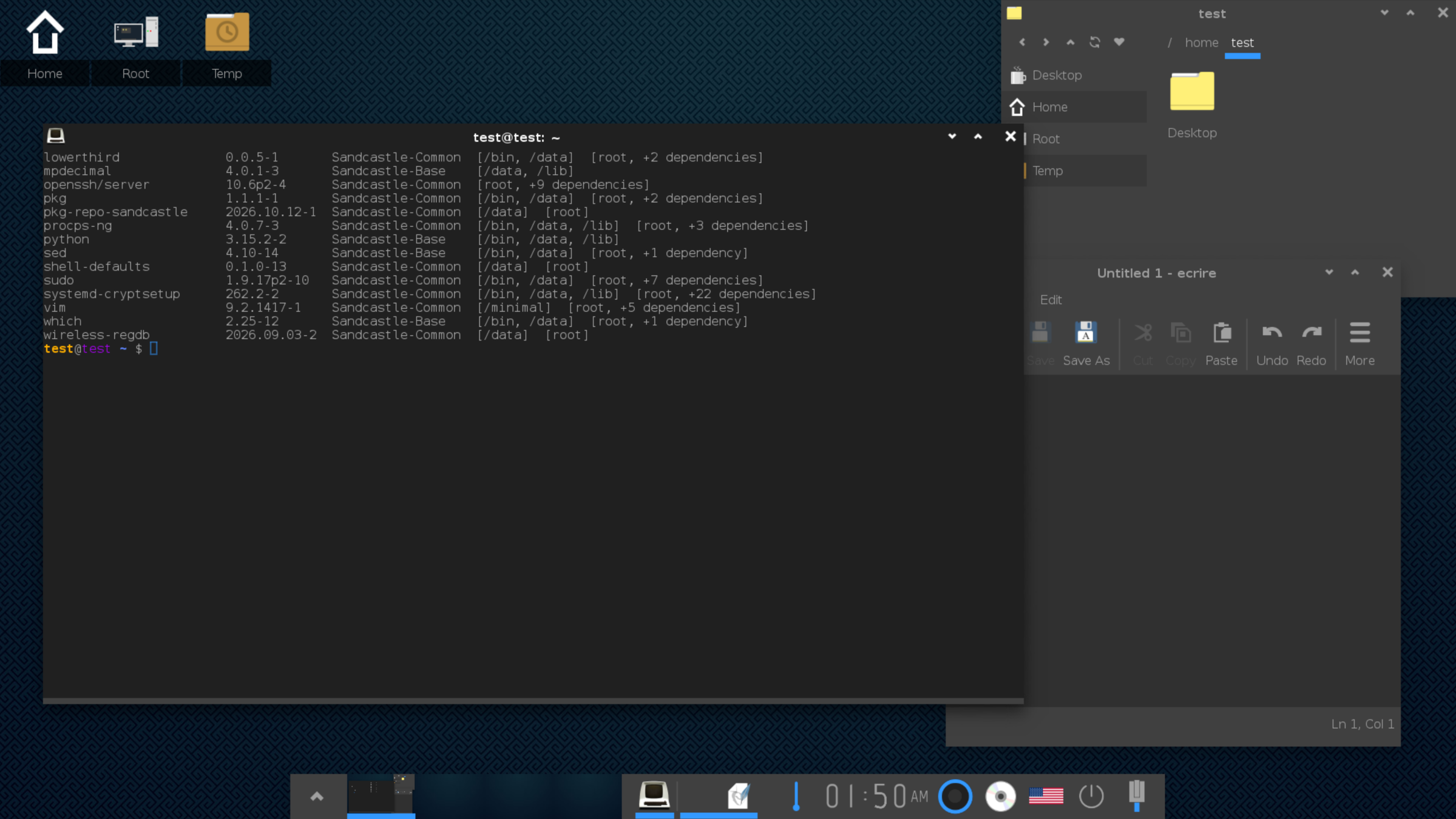
The Enlightenment Desktop has that unique _Rasterman_ style and feel to it.
LTO enabled in several packages
We're slowly working through the repos to find good targets to enable LTO during the build. This work is data driven and means we actually test that the change is an improvement, even if small. We run benchmarks and loading tests to see if enabling LTO is beneficial, and skip enabling it if it isn't. Some things speed up nicely, but in most cases it's a modest 2-5% speed increase. Where unclear or ambiguous we don't enable LTO.
This week's bugs and issues
- The Live USB no longer has a separate
cidatapartition for its seed. The account on the stick is baked into the image itself, and instance-setup knows not to look for a seed when booting a baked root. pkg composenow cleans up its staging tree when it fails or is killed, instead of leaving gigabytes behind.- A user's
pkg composeandpkg provenancenow keep what they download in a cache, instead of fetching it again every time. - A lot of test suites left temporary directories behind in
/tmp. They clean up after themselves now.
Reproducibility audit
- No issues this week.
The reproducibility audit runs 24/7 and continues to rebuild existing packages over and over to validate our reproducible builds promise. Verifying reproducible builds shows how to rebuild a package yourself.
This week's dispatch changes (the builder and pkg)
Publishing on a cadence
Stage repos used to roll twice for every build. A full Common rebuild wrote about 2,200 TUF chains, each with a new ~40 MB archive.json, and the mirror push carried all of them. Now dispatcher rolls them from a publish loop, once things have settled, so the repos get fewer and bigger updates. That's also nicer for anyone who runs pkg upgrade a lot.
Closures and contributors
When an outside contributor's batch of recipes lands, the flush commit now carries their name, and dispatch-web marks closures with external or mixed authors. Long-running closures like common-bumps now move their settled members into a monthly archive, so they don't get slower with every bump that ever landed. The closure list is sorted by last activity, so the active ones are on top.
License review
When I resolve a license, that answer now carries over to other rows with the same file contents. And resolving the same thing again confirms the existing candidate instead of piling up duplicates, so I have to click through a lot less.
upstream-watcher
upstream-watcher understands patch releases like p1 and .post1 better now, so it doesn't file a downgrade by mistake. The CVE matcher also knows that a patch release has the same fixes as the release it's based on.
lowerthird
lowerthird, the quiet boot splash, now draws the disk encryption passphrase prompt itself, and you can still press Esc to get to the console. It also loads a bigger console font before every getty. It's Terminus bold, sized to fit your screen up to 32 pixels, so the console text on a 4K screen is finally readable.
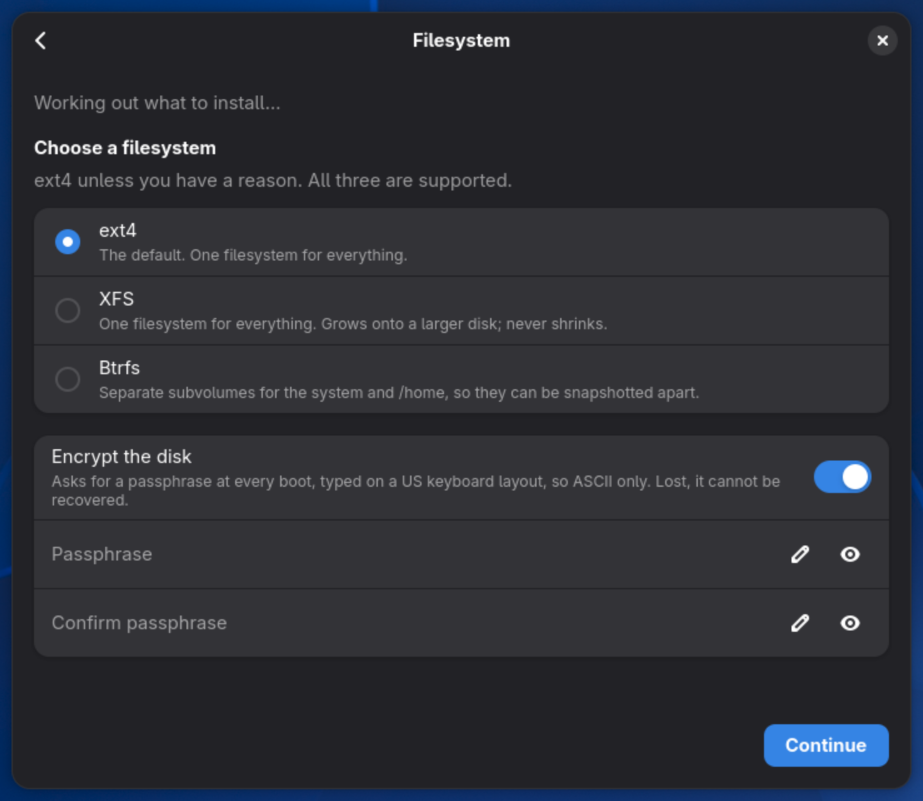
Encrypting your disk requires a passphrase
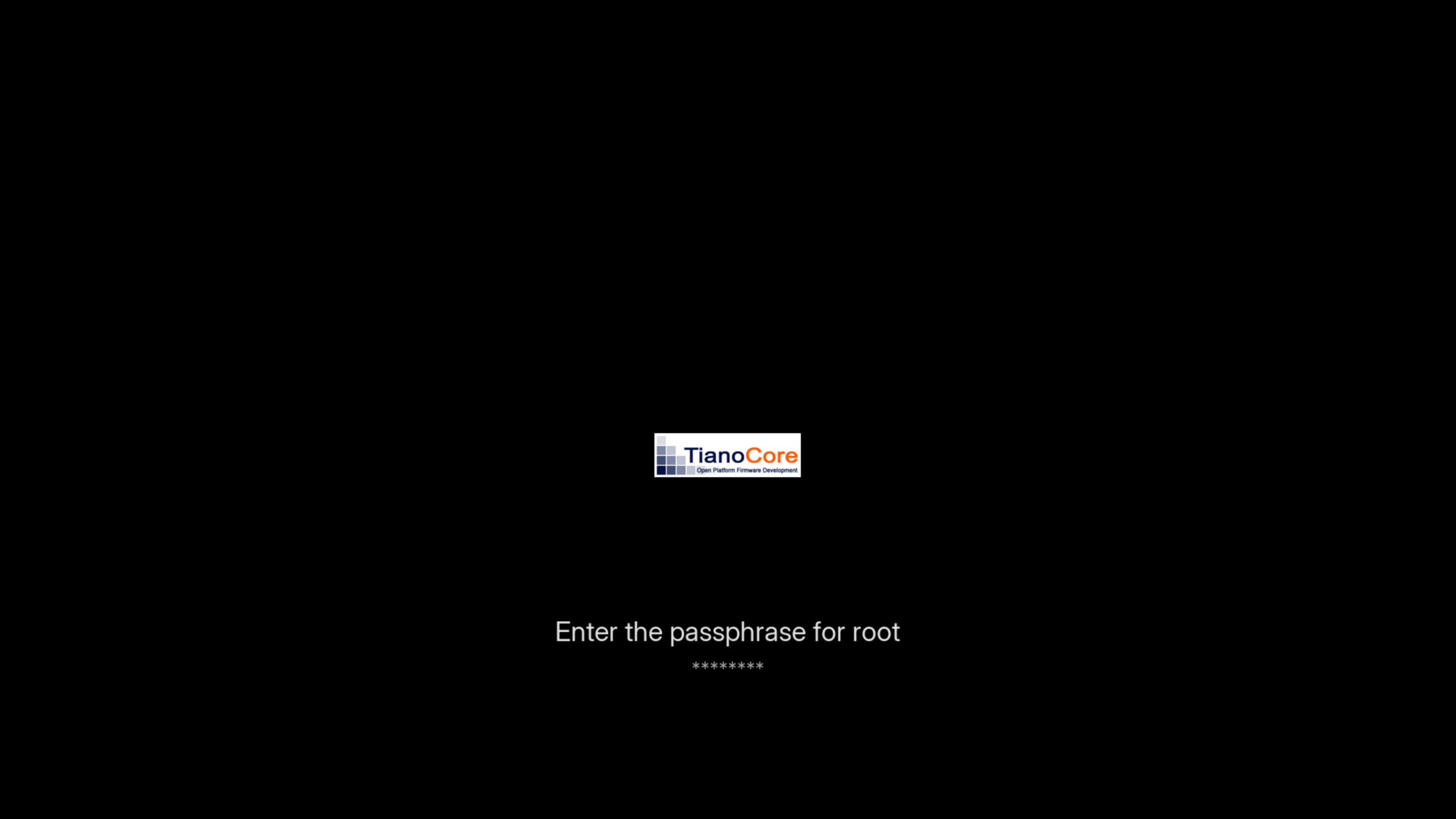
The passphrase entry in progress on the EFI bootsplash screen
Testing
I went through the failing package test runs, and 61 of 3,070 packages failed on at least one runner. Some of those were real problems in the packages, like Qt private API mismatches, missing GI typelibs and QML modules, and missing Python modules. The rest were false positives in the tests, and those are fixed. Every package test now gets sed, grep and gawk, and a few more apps got goldens.
Documentation and website changes
- Buildroot-8.4 was blessed
- New images - 2026.11.3
- The home page now points organizations that ship, or want to ship, their own Linux at /build/ - a slide deck that shows why we're building this project.
- The security page now lists our CVE identity
What's next
We'll roll out the first tombstones in the next week and start work on adding CAP_ capabilities in recipes, allowing packages to do things like capture network packets without root, but instead rely on e.g. CAP_NET_RAW, which has a much smaller attack surface. A few things will benefit from this.
More packages will go through the LTO testing and hopefully get enabled to squeeze out a little extra performance.
As said we are also chewing down the list of CVE identities to make sure that pkg audit becomes more complete, with fewer packages listed as having no CVE data.
PLUG talk is next week
I'm talking at PLUG next Thursday, December 3, at 7pm, at Portland State University. Details are here. Come say hi!
As always, hop on Discord and tell me what you'd like to see packaged, or what could be done better!
--sofar (aka Auke)